VIPs
- Millennials can’t be blamed for being attracted to finance; 1981, their first birth year coincided with a U.S. 10-year yield of 15% which has since drifted to about 2.75%, where it’s hovered for past five years
- For generations, U.S. households have reveled in everyday low and lower prices in exchange for the Chinese financing our mammoth trade deficit; this trade-off fails in China’s economy absent a controlled yuan
- In a freely-traded parallel universe, the flood of foreign investment into China and dollar-denominated revenues would have driven up the value of the yuan and snuffed out the growth of China’s export economy
- Over the past five years, the U.S. goods trade deficit has deepened from roughly $400 billion to $600 billion; this is reflected in the $1.4 trillion of Chinese holdings of U.S. Treasuries, about a fifth of U.S. debt held by foreign countries, the largest in the world
- China cannot afford an escalation in the trade war; in November, Chinese industrial profits fell for the first time in three years while manufacturing output growth is at a decade low
- The start of a slowdown at U.S. ports validates other signs of a slowing economic growth; the forced inventory build ahead of threatened tariff increases which pulled forward growth cannot end well
Born October 12, 1947 in Broomall, Pennsylvania to Armenian immigrant parents, Carl Gugasian was destined to greatness. After earning a bachelor’s in electrical engineering from Villanova, he gained entrée to the Reserve Officers’ Training Corps, an elite program open to our nation’s future officers. Following a stint at Ft. Bragg in the special forces with tactical weapons training, he earned a master’s in systems analysis at the University of Pennsylvania followed by doctoral work in statistics and probabilities at Penn State. Years later, the Nobel Prize in…
Wait, Gugasian may have achieved military and academic prominence, but he grew up to be the “The Friday Night Bank Robber,” the nation’s most prolific thief, having robbed more than 50 banks over a 30-year period netting more than $2 million.
If anything, the trend of brilliant minds going to waste has flourished since Gugasian’s 2002 arrest. That is not to say Millennials are wayward, but many have flocked to the wonderful world of finance with hopes to get rich quick. The most populous U.S. generation cannot be blamed for being attracted to the industry — their first birth year of 1981 coincided with the yield on the benchmark 10-year Treasury cresting at 15%. Since then, the yield has drifted to about 2.75%, where it’s hovered for the past five years.
The persistent good behavior in rates makes it easy to forget one of the chief catalysts that set rates marching south — China. At the risk of oversimplifying, quid pro quo was also a key player.
The briefest bit of context: For generations, U.S. households have reveled in everyday low and lower prices in exchange for the Chinese financing our mammoth trade deficit. It was more than pure commerce, however, that incented China, though the growth of its economy has been the ultimate beneficiary.
Until 2015, China’s vise grip on its (not-free) economy required the management of the yuan via a peg to a set exchange rate against the dollar. In a freely-traded parallel universe, the flood of foreign investment and dollar-denominated revenues would have driven up the value of the yuan. To prevent this, which would have snuffed its export sector’s potential, the People’s Bank of China had to trade yuan for greenbacks via U.S. Treasury purchases.
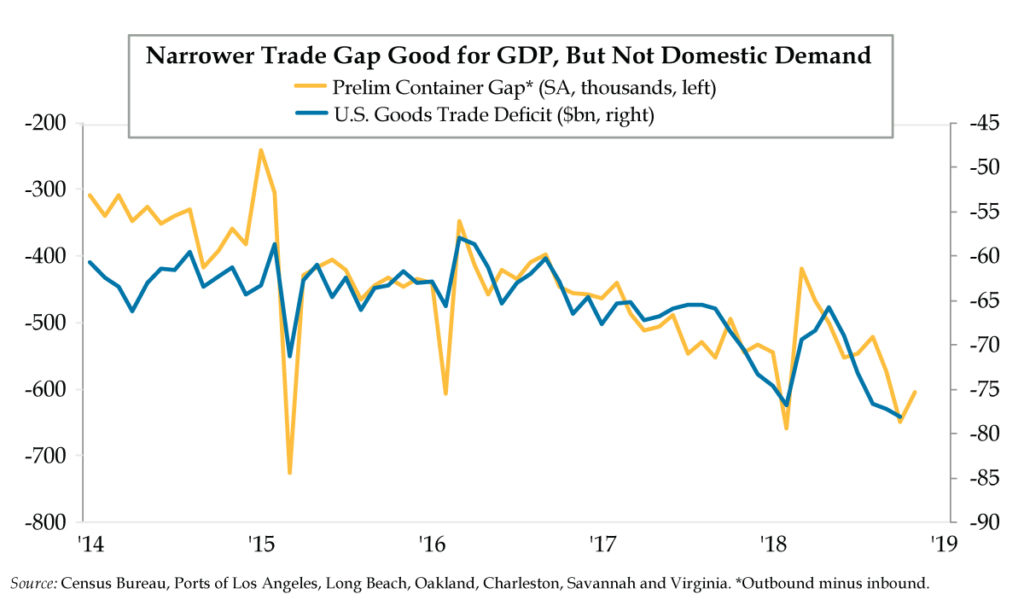
In 2015, China slightly loosened its currency’s trading, tying the yuan to a basket of other currencies in addition to the dollar (the dollar still dominates the equation). That’s not to say the countries’ reliance on American consumers has ebbed. Over the past five years, the U.S. goods trade deficit has deepened from roughly $400 billion to $600 billion.
This deficit is reflected in the $1.4 trillion of Chinese holdings of U.S. Treasuries, about a fifth of U.S. debt held by foreign countries, the largest in the world. That being said, China’s holdings have fallen in each of the five months through October and some worry that outright sales of U.S. Treasuries will be a “nuclear option” if the trade war fully escalates.
The odds of such a rash move on China’s part are scant given they’d be creating losses when its slowing economy can least afford it. In case you still harbor delusions that Chinese authorities are fabricating a slowdown as a trade war negotiating tactic, we’ve m oved past that point of convenience. In November, industrial profits declined over prior year for the first time in three years. Meanwhile, manufacturing output growth is hovering at a decade low which helps explain decelerating factory sector inflation.
No doubt, Wednesday’s announcement that trade talks would be held in mid-January ahead of the March 1stexpiration of the rising-tariff détente poured fuel on the fire of Wednesday’s short-covering monster rally. The administration’s follow through within 24 hours was a buzz kill. Reuters reported that an executive order could to be signed as early as January declaring a national emergency and banning U.S. companies from using telecom equipment made by China’s Huawei and ZTE.
Is corporate espionage a serious issue? Absolutely. But might it also be time for a tamer form of dispute resolution? By the sounds of silencing cranes at our nation’s ports, both countries should pause to contemplate what happens if Trump gets his wish of a narrowing trade gap.
The government shutdown will delay the release of all manner of economic data, including today’s November advanced goods trade deficit. But taken together with the slump in Chinese industrial profits and a dissipation in the frenzied activity at our nation’s port, we don’t need the data to validate the dénouement of the panic buying that had – past tense – juiced U.S. economic growth.
The forced inventory build that pulled forward growth cannot end well, despite what our president’s brightest and closest trade advisors envision. The bank of tomorrow’s growth has been robbed blind.