VIPs
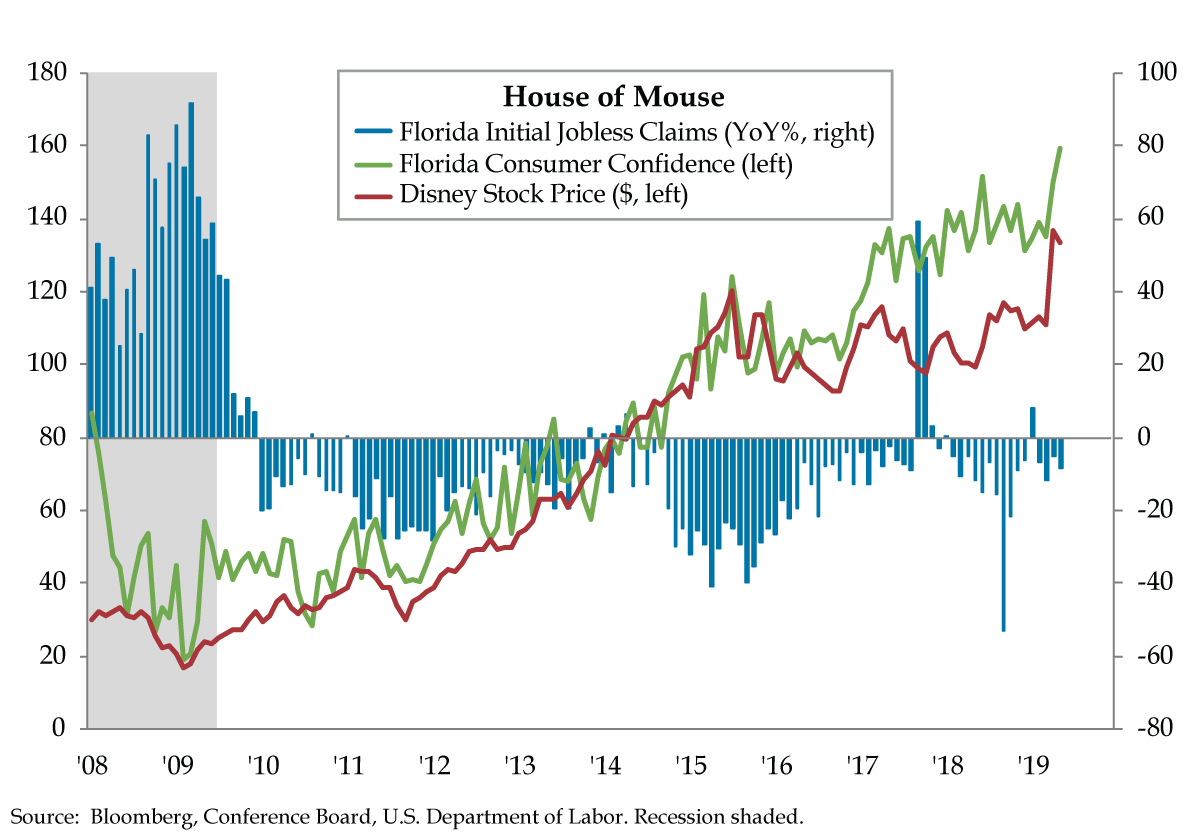
- Consumer confidence and unemployment are firmly linked; Florida’s consumer confidence hit cycle highs in May while jobless claims are 8.1% lower on the year reflecting the 3.4% unemployment rate, the lowest rate of the eight biggest states
- Disney’s stock price is tightly correlated with Florida’s consumer confidence and has flagged sentiment’s low points and high points throughout the current cycle; most recently, Disney’s stock has moved in lockstep with this April’s and May’s surges in sentiment
- Florida is the fourth most leisure-intensive state with 6.1% of gross state product tied to hospitality; given travel is the most discretionary budget item and with anecdotes of one-in-four U.S. families forgoing vacations this summer, Florida has risen in the ranks on our watch list
The Joy of Painting via the United States Air Force. That’s how Bob Ross, known as the “happy painter,” went from Point A to Point B in his lifetime. The bearded art instructor and television host with his iconic ample head of hair was born in Daytona Beach, Florida in 1942. Even after his passing in 1995, Ross managed to ascend from a 1980s and 90s TV personality to 21st century Internet celebrity. Thank YouTube for reviving his popularity via small-screen transmissions to younger generations.
For Ross, it all started in 1961 when the Floridian enlisted in the Air Force and was stationed at Eielson Air Force Base in Alaska. The 49th state is where he first found the inspiration to paint trees, clouds, mountains and lakes. Having held military positions that required screaming down to cadets, Ross vowed to never raise his voice again after leaving the military. When asked about his trademark laid-back approach, Ross recalled, “I got a letter from somebody here a while back, and they said, ‘Bob, everything in your world seems to be happy.’ That’s for sure. That’s why I paint. It’s because I can create the kind of world that I want, and I can make this world as happy as I want it. Shoot, if you want bad stuff, watch the news.”
Ross’s fellow present-day Floridians must be skipping the news. Yesterday’s U.S. Conference Board consumer confidence report revealed Florida as the most optimistic among eight top states including California, Texas, New York, Illinois, Pennsylvania, Ohio and Michigan. Florida consumer confidence and forward-looking consumer expectations both hit cycle highs in May. And why not? The Sunshine State has the second highest in-migration behind The Lone Star State. Florida residents enjoy no state income tax and, most importantly, Florida’s unemployment rate of 3.4% is the lowest of these eight top states. Consumer confidence and unemployment are intimately, dare say, intuitively, intertwined.
Speaking of unemployment, Florida’s initial jobless claims continue to wave the green flag for the state’s labor cycle. Barring the occasional hiccup here and there, the year-over-year trend in initial claims has been on the decline since 2010. Thus far in May, claims are 8.1% below year-ago levels. The sole outlier made landfall alongside 2017’s Hurricane Irma. But that two-month spike in September and October of that year was quickly extinguished.
An even deeper dive into Florida’s workforce security statistics reveals continuing claims in the broader nonfarm sector – those collecting unemployment benefits, not just applying for them –running 13.0% south of their April 2018 level. In fact, there have been only two months since 2010 when the year-over-year trend in Florida continuing claims posted an outright increase – February 2014 and October 2017.
Florida is also home to one of the happiest places on Earth where it’s always a small world after all. Of course we reference Mickey and friends’ Walt Disney World! Do we imply that positive economic sentiments can be home grown, innate to the state and related to the House of Mouse? You be the judge. Disney’s stock price (ticker DIS) has an uncanny correlation to Florida consumer confidence.
Truth be told, we’re as surprised as you are since Disney’s revenues are much more diverse than theme park admissions and hotel revenues. Be that as it may, since 2008, ticker ‘DIS’ has tightly tracked the evolution of Florida household sentiment. The stock’s trough coincided with the February 2009 low point in sentiment.And it coincided with a July 2015 cycle top. More recently, Disney’s stock has mirrored the April and May 2019 sentiment surge. And that’s just a few examples.
It would seem tourism has been an integral part of Florida’s economy since Disney’s Magic Kingdom opened its gates on October 1, 1971. The leisure and hospitality sector that includes the four Disney theme parks and all Disney resort hotels – as well as the numerous other Florida amusement parks and places to lay your head on a pillow – accounts for a material 6.1% of the gross state product. That makes Florida the fourth most leisure-intensive state in the nation behind Nevada, Hawaii and Vermont.
As cycle chasers, we relish in finding unique prisms through which to illustrate where the economy is headed. Since travel is the most discretionary household budget item, the economies of leisure-intensive states are always on our radar screen. That said, the current late-cycle nature of the U.S. economy, with anecdotes of one-in-four U.S. families forgoing vacations this summer proliferating, has elevated these locales on our watch list.
Bob Ross traveled to a state far from home to serve his country. There, he became inspired to paint happy little trees. You need not travel at all to find happy Floridians basking in the outperformance of their hospitality industry. Simply type ticker ‘DIS’ into your stock screener of choice.