Described as “the pictorial Shakespeare of our time” by Steven Spielberg, “a giant” by Martin Scorsese, and “one of my true heroes” by Spike Lee, Japanese filmmaker Akira Kurosawa is one of cinema’s all-time greats. While best known for epics like Seven Samurai, we’re partial to High and Low, his 1963 crime thriller in which a wealthy executive of a shoe-making company finds himself victim to an extortion plot. The story follows Mr. Kingo Gondo who puts his life savings on the line to try and gain control of his company, National Shoes, via leveraged buyout. However, the sudden kidnapping of his chauffeur’s son forces the ruthless businessman to choose between his life’s work and paying the ransom to save the young boy. Gondo lives in a beautiful home on a hilltop, overlooking the poor residents of a shantytown below, one of whom the police believe is responsible for the crime. Part police procedural and part class commentary, the film’s game of cat-and-mouse between cops and perpetrator is equal parts nerve-wracking and enthralling.
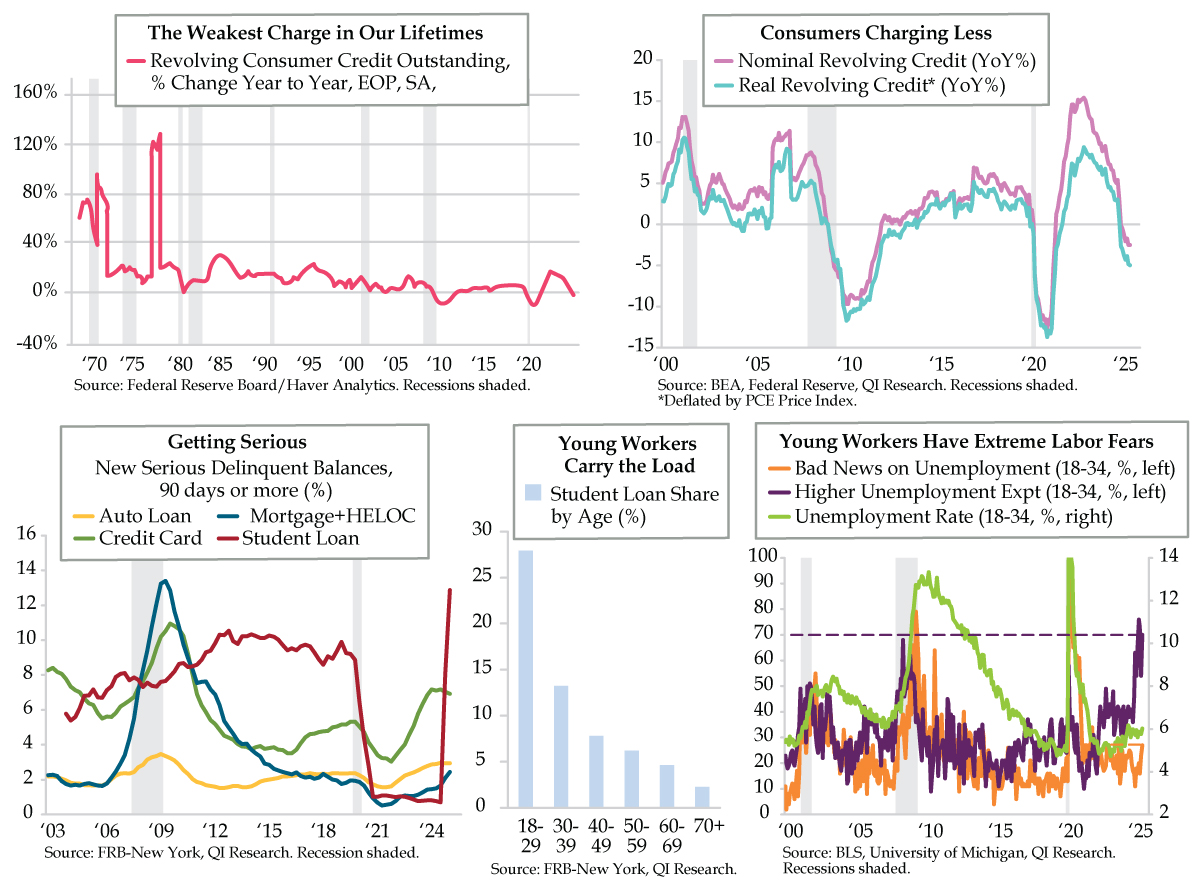
Here at QI, we do our best to comb through the latest economic data, calling out “highs” and “lows” to our readers that pique our interest… or ring alarm bells. The first chart in this Monday missive does the latter, and speaks to a “low” pointed out by our Mentor-in-Chief, Dr. Lacy Hunt. Per the sage himself: “Revolving consumer credit declined in the 12 months ended June. This was weaker than at the start of all the recessions since 1970. This indicator, historically, has not turned negative until the economy was in recession.” There’s nothing like a “weaker than any point since you were born” data point to bring it home. It, once again, reminds us that the recessions of 1970, 1982, and 2001 featured rising consumption; the primary catalyst into economic contraction is always falling business investment. As such, to Hunt’s point, given credit card spending is already contracting, the current recession will be deeper and more prolonged than others in our lifetimes.
When optimism is in short supply, consumers are less inclined to borrow from tomorrow’s paycheck to pay for things today. The top-right chart illustrates the year-over-year (YoY) path of revolving credit going back to 2000, care of the Federal Reserve’s G.19 Consumer Credit release. June’s -2.5% YoY decline on a nominal basis continues the abrupt trend reversal from December 2022’s 15.4% YoY peak (pink line). Meanwhile, on a real basis (deflated using the PCE Price Index), the pullback on plastic usage is even more drastic, having fallen -5.0% YoY in June. This marks a more than four-year low and is on par with levels seen as we were exiting the Great Recession (teal line). While not pictured, nonrevolving credit (i.e., auto and student loans) ticked up 1.6% YoY, consistent with keeping car sales afloat, as discussed in last Tuesday’s Feather.
The New York Fed’s latest Quarterly Report on Household Debt and Credit also gave us some insight into the difficulties consumers are encountering meeting their debt obligations. Looking at the flow of balances becoming newly delinquent for 90+ days, that rate for credit cards ticked down slightly from 7.04% to 6.93%, but nonetheless remains at elevated levels on par with the 2007-09 downturn (green line). The 2.93% rate for auto loans is also consistent with recession (yellow line). Meanwhile, mortgage/HELOC rose from 2.1% to a post-pandemic high of 2.44% in 2025’s second quarter (blue line). A deep dive in the New York Fed’s Liberty Street Economics blog noted that it’s (unsurprisingly) FHA loans seeing the fastest rise in delinquencies, concentrated geographically in the South.
None of these, however, hold a candle to the meteoric rise in serious delinquencies for student loans, which borrowers can no longer ignore without consequence. Total educational debt outstanding was a stout $1.64 trillion in the second quarter, 10.2% of which was more than 90 days delinquent. New seriously delinquent balances jumped to 12.88%, a record high (red line). By contrast, just two quarters ago, that rate stood at 0.7%. Unfortunately for America’s youth, they own the lion’s share of that $1.64 trillion: 41% of outstanding student loan debt belongs to those aged 18-39, with more than a quarter held by those under 29 (blue bars). And it’s this cohort that feels most disenfranchised in the current labor market.
Worries that AI will wipe out entry-level positions and fundamentally alter the working world are most acute among Generation Z, those with the longest runways to retirement. Anecdotes abound of the challenges new grads are having landing roles, and early career professionals who started their first job before ChatGPT’s launch in November 2022 often feel as though they caught the last chopper out of Vietnam. For the age 18-34 cohort, University of Michigan Higher Unemployment Expectations printed at 70% in July, more than double the long-run average of 30.6% back to 2000 and the fourth worst on record behind May 2025 (73%), April 2025 (76%), and May 1980 (78%) (purple line). Similarly, Bad News Heard on Unemployment for this cohort has ticked up in recent months to 27%, its highest since February 2023, in the wake of the first major layoff wave this cycle. Meanwhile, youth unemployment, at 6.028%, has yet to unwind as it did in past cycles, and has risen by four tenths since March (lime line). All signs point to a continued upward trajectory.
To summarize, young people 1) own the most student debt and 2) are feeling the most pressure in the current job market. Case in point: a recent Financial Times analysis, using data from the Census’s Population Survey, which found the unemployment rate for men aged 22-27 was the same, irrespective of whether they had a college degree or not. For disgruntled youth, who feel they’re not getting the higher education ROI promised and view home ownership as a pipe dream, it’s easy to empathize with their frustrations, akin to the shantytown residents looking up at Gondo’s exquisite hilltop mansion in High and Low. Have we mentioned this is all unfolding with the Midterms just over a year away?