“A rigorous proof of this would of course be desirable; after some fleeting unsuccessful attempts, however, I have provisionally put aside the search for this, as it appeared expendable for the immediate objective of my investigation.”
Bernhard Riemann, 1859
The famous “Riemann Hypothesis” is one of pure mathematics’ greatest unsolved mysteries and has remained unproven for 167 years. Since Ancient Greece, mathematicians have been fascinated by prime numbers, the “building blocks” that create every other number (e.g., 24 = 2 x 2 x 2 x 3). Prime numbers seem scattered at random on the number line (2, 3, 5, 7, 11, 13, 17, 19, 23, 29, etc.), but Riemann’s Hypothesis predicts a precise rhythm for how often they occur. Perhaps, if Riemann had not succumbed at just 39 to tuberculosis, he could have provided the proof himself. Since 2000, a nonprofit called the Clay Mathematics Institute has offered a $1 million prize to anyone who can successfully prove the concept, upon which much of modern mathematical research is predicated. For a far more in-depth explanation of what the Riemann Hypothesis is (one that shows just how beautiful theoretical math is!), we recommend this video for your viewing pleasure.
On Friday, our X feed was filled with posts on two topics. First, the market’s worst week since the pandemic and concerns over whether the AI bubble has truly burst. Second, news that Levent Alpöge, a mathematician and Anthropic employee, had leveraged Claude to formally prove the Riemann Hypothesis. The watershed (and also, somber?) nature of this moment, with an AI tool overpowering more than 150 years of humanity’s greatest efforts, cannot be understated.
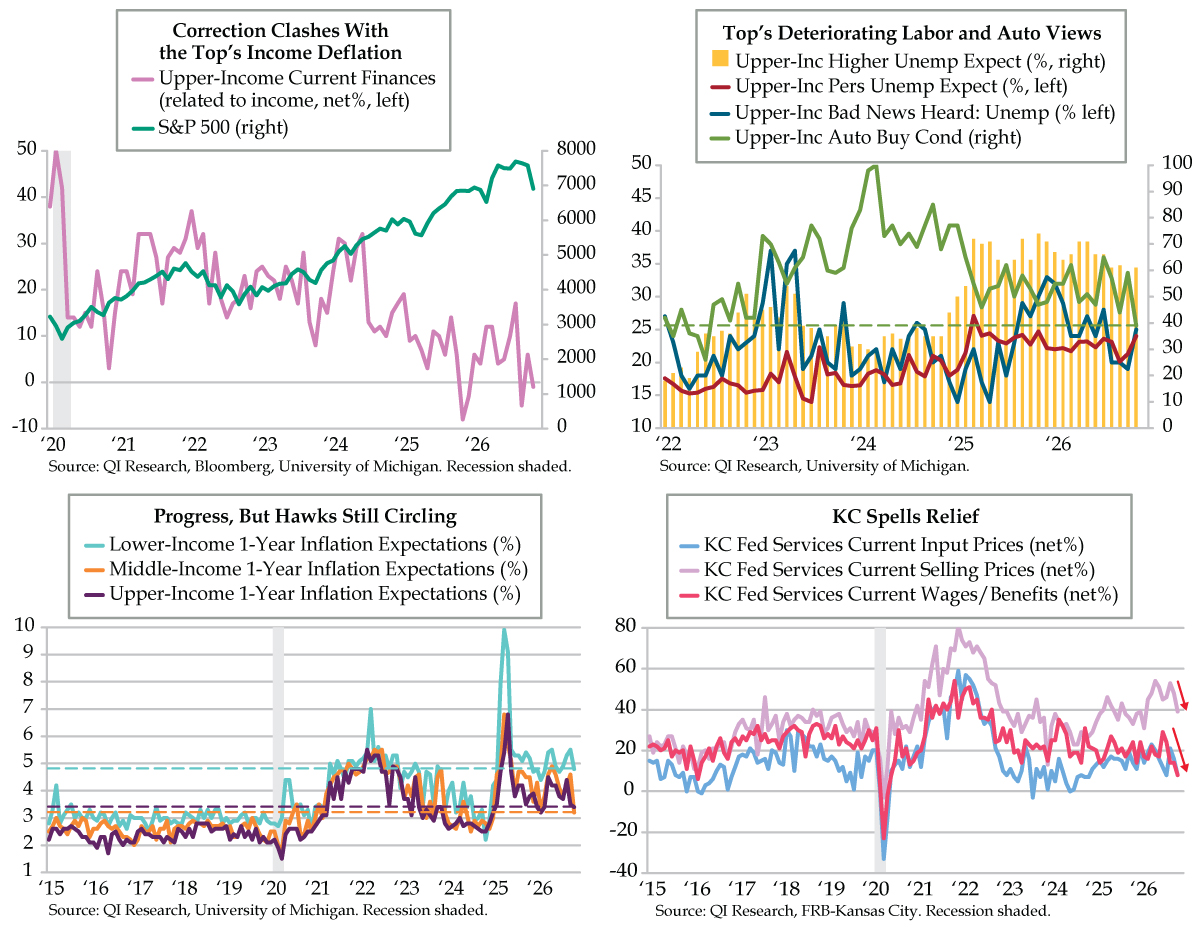
If AI is on the precipice of rendering the human pursuit of new knowledge a pointless exercise, it also looks poised to disrupt household balance sheets worldwide after last week’s market shake-up. The wealth effect over the last several years from the AI rally has been the life raft upon which consumption in the top of the “K” has floated. In the post-pandemic era, as the S&P 500 has continued to dance higher, University of Michigan perceptions on “Current Finances Related to Income” for the Upper-Income Cohort have been on a downward trajectory (dark lilac line). Unsurprisingly, the latter gauge hit a local peak of 37 in January 2022, right as the “Great Resignation” was coming to an end and months before Amazon kicked off the first layoff cycle later that year. November’s 7-point decline to a net -1% is just the fourth net negative print since the pandemic. That this is the starting point for household incomes, right as equities are headed to correction territory, is cause for concern.
At the same time that Upper Income views on their Incomes are wavering, as are their perspectives on Labor and Autos. Higher Unemployment Expectations for this cohort have been above 60% for 20 of the last 21 months, and November’s 61% continued that record streak of persistence (yellow bars). Meanwhile, Personal Unemployment Expectations ticked up 2.7 points to 24%, their highest level in 12 months (red line). So, too, did Bad News Heard on the subject, rising 6 points to 25%, the worst since May as major companies including Alaska Airlines, Kroger, Yelp, and Dropbox have all announced headcount reductions right on the holiday season’s doorstep.
Meanwhile, Fed tightening continues to wreak havoc in the most rate-sensitive sectors. We highlighted the impacts on housing in the weak NAHB data in Thursday’s Feather and noted the uptick in Baby Boomer retirees trying to sell second homes in the Intelligence Briefing. Beyond housing, the Auto sector has also been under siege. Upper-Income Auto Buying Conditions’ 20-point decline to 39 takes them to their lowest level since June 2022 (green line). As for lower-income cohorts, the artificial juice that the Auto sector got thanks to tax refunds from the One Big Beautiful Bill will not re-materialize in 2027, meaning the outlook should continue to deteriorate. Similarly, the uptick in texts and e-mails we’ve gotten from local car dealerships enticing us with generous trade-in offers and deals on unsold 2026 models is yet another “anecdata” point we take to heart.
Odds of another 25-basis-point rate hike in December still sit at around 90% and were little moved Friday despite the market’s sell-off. Whether further chaos will force Fed officials to change their calculus (remember that they have followed Bernanke’s lead in backstopping the stock market no matter what for the last 40 years) remains to be seen. For now, there’s enough ammunition in the hawks’ chambers to justify another hike to close out the year, even as fuel pressures have ebbed. On that note, consumers also saw their year-ahead inflation expectations pull back significantly in November. Lower-Income fell 0.7 points to 4.8% (aqua line), while those of their counterparts in the Middle sank 1.4 points to 3.2% (orange line) and Upper slid one-tenth to 3.4% (purple line). The average -0.7-point decline across the three groups was the best one-month result since the summer of 2025 in the aftermath of Liberation Day. While still above their pre-pandemic levels, the softening is a welcome sign, and the aggregate 3.7% result is far closer to February’s pre-Iran War 3.4%.
In her summary write-up, UMich Survey Director Joanne Hsu noted that “despite the softening in inflation expectations, consumers continue to report overwhelmingly that inflation — rather than unemployment — will cause greater hardship for consumers in the next one or two years.” The latest Kansas City Federal Reserve Services Survey lends credence to the idea that further relief is in store on the pricing front for consumers. Current Input Prices remain historically high but dipped 9 points to a net 49% (lavender line). Meanwhile, Current Wages/Benefits cooled 6 points to a net 8%, a post-pandemic low (fuchsia line). As for Current Selling Prices, the 8-point slide to a net 8% tied with August for the lowest print in roughly two years (light blue line). All three results run counter to a re-acceleration on the pricing front. While proving the Riemann Hypothesis without AI may require deep expertise in number theory and complex analysis, making monetary policy based on “where the puck is going,” to quote one Beth Hammack, shouldn’t be anywhere near as complicated.