VIPs
- Even though Sweden’s economy is slowing down more quickly than expected, the Riksbank is moving to exit its negative interest rate policy (NIRP); policymakers have indicated the current -.25% repo rate will likely be raised to zero in December
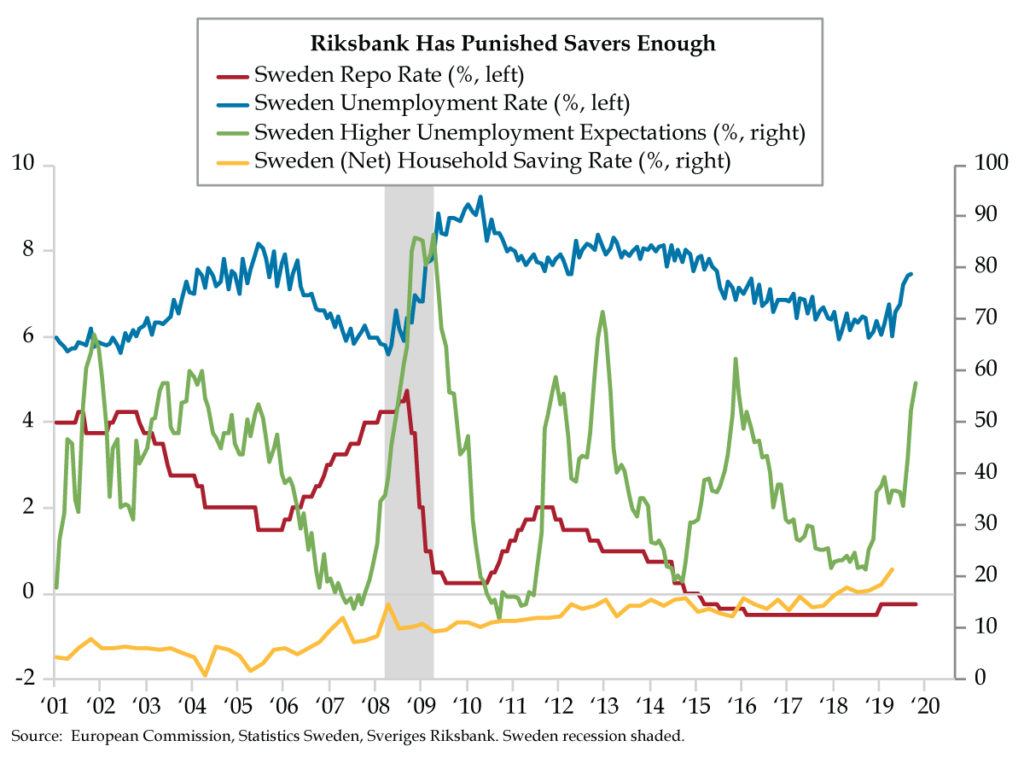
- Sweden’s unemployment is up 17.0% in 12 months, the current cycle’s largest move with employment contracting year-on-year for three straight months; higher unemployment expectations hit 57.6% in October and the majority of Swede’s expect recession
- While escaping NIRP is likely to drag on the economy, the offsetting consequences have outweighed economic growth; Swedish households’ saving rate rose to a record 21.3% in 2019’s second quarter and will cushion the harder economic times the economy faces
Know any “guy musicals” that blend a soul-stirring soundtrack with car chases? There’s one: The Blues Brothers. The 1980 flick expanded the Saturday Night Live characters “Joliet” Jake Blues (John Belushi) and Elwood Blues (Dan Aykroyd) to the big screen with a legion of guest stars and great blues tunes. The film shifts into overdrive after the Blues Brothers go to church. During the sermon, Reverend Cleophus James (James Brown) asks the congregation, “Do you see the light?” A glowing Jake does and his vision is to get the band back together so they can raise $5,000 to save their childhood orphanage. From that point on, Elwood’s mantra becomes the most recognizable line of the movie: “We’re on a mission from God.”
The Riksbank has seen the light all the way to exiting negative interest rate policy (NIRP). At its October 24 policy meeting, Sweden’s central bank indicated that the current -0.25% repo rate “will most probably be raised in December to zero percent.” Why, you may be asking, would any central bank be raising rates when industrial recession is causing global growth to slow down, prompting umpteen number of central banks to cut rates?
Your question is more than valid given the Riksbank has also acknowledged that Sweden’s economy is slowing down faster than anticipated. Consider policymakers’ latest assessment that headwinds “from the trade conflict between the United States and China and the unclear situation around the United Kingdom’s withdrawal from the EU continue to create uncertainty over growth prospects.”
But here’s where they lost us in the October policy statement: “However, the slowdown implies a normalization of an economic situation that has been strong for many years with high growth and favorable development on the labor market.” Does today’s diagram över dagen look like normalization to you?
The Swedish unemployment rate has risen from an unrounded 6.003% in April 2019 to 7.448% in September. The last 1.445 percentage point spike in the unemployment rate over a five-month span happened during Sweden’s 2008-09 recession. The level of unemployment is up 17.0% over the last twelve months, the biggest move of this cycle, and the level of employment has contracted on a year-over-year basis for three straight months and four of the last five, another down cycle not seen since the last recession.
This (hard-data) labor dislocation does not resemble the recession scares for Swedish households that took place in 2011, 2012 and 2015. Why those years? They coincided with spikes in higher unemployment expectations (green line above). October’s reading of 57.6% for Sweden reported in the details of the European Commission’s Consumer survey stands as the second highest for all European countries, lagging only Spain’s 58.2%. Main Street’s fear of recession is shared by a majority of Swedish households.
It follows that the Riksbank’s rate guidance is driven by a separate factor? The October Monetary Policy Report stated, “…if negative nominal interest rates are perceived as a more permanent state, the behavior of agents may change and negative effects may arise.” Moreover, it noted, “low interest rates can create incentives for substantial risk-taking in the economy. Assets may become overvalued, risk may be incorrectly priced and the indebtedness of various agents may increase in an unsustainable manner.”
The Riksbank is justified in voicing concerns over household indebtedness as it inflated a housing bubble that pushed up home prices by 44% over a six-year period before a slowdown ensued earlier this year.
One of the best ways to counter a high debt burden is with higher saving, allowing households to be resilient in the face of a downturn in the economy and the risk and, more importantly, the reality of higher unemployment.
The good news is the (net) household saving rate rose to a record 21.3% in 2019’s second quarter. (Can you imagine U.S. households saving that much? Take that back. Tripling the U.S. saving rate would slam our 70% consumption-driven economy into a hard recession.) Unfortunately, savers are earning a paltry 0.16% on deposits of two years or less and all of 1.36% to park their money for longer. That means that households will have to continue to save out of current income even when the repo rate hits zero.
Ending NIRP in Sweden should give financial executives a measure of relief. Jakob Carlsson, CEO of Swedish insurance and banking group Lansforsakringar, told a Financial Times conference recently that negative rates were hurting the financial system and that the Riksbank should push ahead with a rate increase even if it hurt the economy. Sounds a lot like the Blues Brothers, on a mission from God. Now if only the rest of the world’s central banks erring in their NIRP ways could find that same religion.