VIPs
- The April jobs report came in well below expectations, and the U.S. Chamber of Commerce is now calling for an early end to supplemental unemployment benefits; at -111,000, Temporary Unemployment also saw its second-largest monthly collapse on record
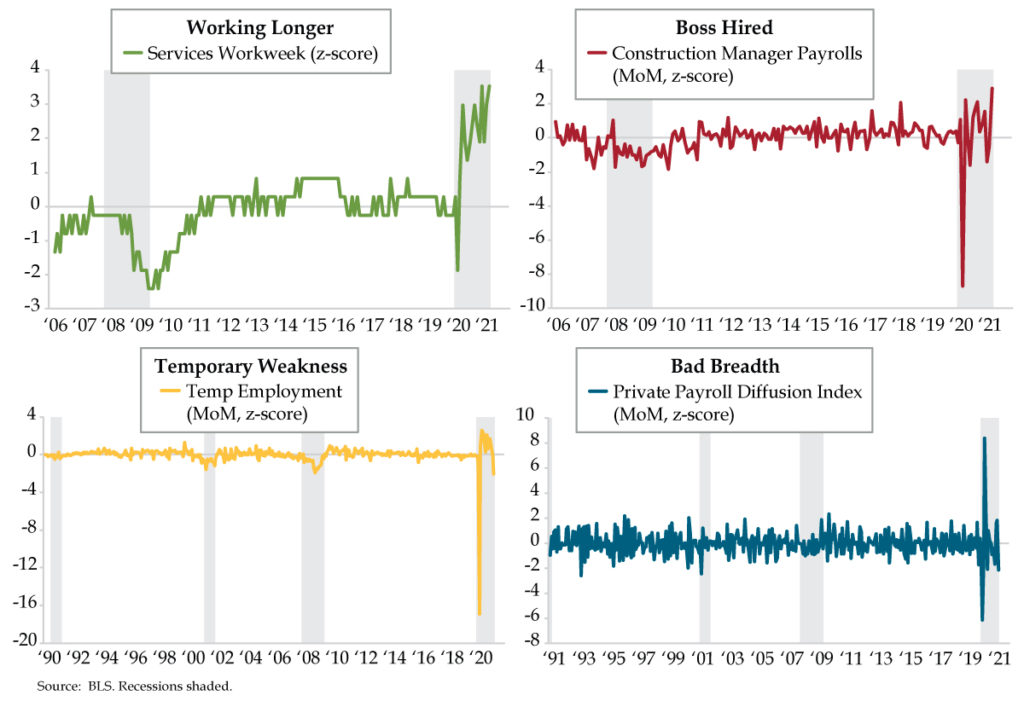
- Employers are getting more out of their workers than ever, with the 35-hour workweek a record matching January’s print, per the BLS; while the Manufacturing Workweek was the same, the 33.9-hour Services Workweek registered as a 3.52 z-score, well above historicals
- The Private Payroll 12-month diffusion index fell to 60.1% from 75.7% in April, the fourth largest monthly decline in the last thirty years and a sign of bad breadth; as a -2.1 z-score, this print is cause for concern, since drops this steep have tended to signal peak growth
We must ask that you refrain from trolling. If you can’t resist, we recommend doing so between late August and early November. In the spirit of evolving to avoid extinction, for thousands of years, salmon swim hard…upstream. The two-mile journey from the ocean to quiet streams typically takes two weeks. So arduous is the journey, it saps their lifeblood; most salmon die after they’ve laid their eggs. It’s critical to get all the way to shallow waters and small rivers as larger fish in the ocean would otherwise feast on the eggs that safely hatch as “fish fry.” And then there’s the shelter element – tranquil waters ensure the eggs don’t get washed away by heavy currents. The one risk that can’t be escaped is trollers. Erstwhile west coast fishermen and fisherwomen know as well as any salmon that autumn’s first big rains start the clock on the big swim. Those perfectly positioned at the inlets and bays that the salmon spawning rivers dump into can troll to their heart’s delight for a King, Coho, Pink or Sockeye.
There are the exceptions. Between 5-10% of salmon live to swim another day, especially the Rosiest of them. On Friday, QI was fortunate enough to visit with a big fish who’s already survived one spawning season and fully intends to survive the next, trollers be damned. We speak of QI friend David Rosenberg. We’re fortunate enough to be among those who call him Rosie, which fits his cheery personality, but was ironically earned during his brutal journey on the sell side at Merrill Lynch when he was castigated for predicting housing was in a massive bubble. He was in rare form then. And he’s in rare form today, fighting above his weight as part of the teensiest minority calling for inflation to relent.
His perch in Toronto gives him a unique perspective – he’s in a part of the world where the pandemic still dictates everyday life; the former road warrior hasn’t budged for 15 months and counting. His second vaccine won’t arrive until July. Moreover, he understands supply and demand. To take but one example, Rosie’s got a front row seat to Canadian sawmills pouring money into satisfying demand. Vancouver-based West Fraser, the world’s largest lumber producer, is expanding five of its lumber mills’ capacity and seeing improved shipping times after adding transportation resources. In Rosie’s estimation, supply will rise to meet demand. We’ll take a deeper dive into our visit with him in the upcoming Weekly Quill.
As for the bomb dropped at 8:30 EST Friday morning, evidence of man-made labor shortages was written all over April’s jobs data. The U.S. Chamber of Commerce is calling for an early end to the $300 in extra unemployment benefits given its analysis that revealed one in four recipients is making more to stay sidelined than they earned working. The more companies are harmed by this policy backfire, the greater the pressure on politicians to alleviate this supply constraint.
A few posited that seasonals skewed the data. QI amiga and labor market guru Philippa Dunne posited that the opposite was likely given firms are “holding onto workers through months that usually involve heavy layoffs” in a post-pandemic world.
The data reveal employers are also getting more out of their workers than ever, which is on vivid display in the latest productivity data. The 35-hour workweek, a record matching January’s print, only tells half the story given the leading manufacturing workweek was unchanged. The 33.9-hour Services Workweek was so long historically we chose it as the first of four z-scores (deviations from the mean adjusted for volatility) to clock using Friday’s data. The 3.52-read (green line) begs for a bigger scale.
Managers in the construction sector also saw enormous gains reflected in the record high 2.91 z-score (red line). Of this giant move, QI’s Dr. Gates asks: “Has a construction worker shortage led to record gains for supervisors? Is that scarcity causing more skilled managers to be brought onto payrolls? Are these managers being hired in prep for more workers? Maybe it’s a vote of confidence for the recovery.” We know housing is hot. But we also know nonresidential construction is not. File this in the “Stay Tuned” folder.
At the other end of the spectrum lies Temporary Employment which, at -111,000, suffered the second largest collapse on record behind the lockdown month of April 2020. To contextualize the -2.05 z-score (yellow line) is lower than that November 2008’s recessionary low point. We know that there was a ton of hiring to satisfy the rush of domestic travelers who, stimmy checks burning a hole through their wallets, swarmed fun spots during Spring Break. Did those jobs vanish after the vacations ended?
And finally, we nod to the labor market’s Bad Breadth. There are only three other months in the past 30 years that have seen a decline as deep as that of last month’s, when the 12-month diffusion index fell to 60.1% from 75.7%. Of the four depicted in today’s quad of charts, this -2.1 z-score (blue line) raises the biggest red flag given moves of this magnitude tend to signal peak growth. If March did mark the peak, that means April was on the other side. While neither of the last two months does a trend make, if that’s the case, the swim from here on out will be upstream.