Vinny: “Does that freight train come through here at 5:00 A.M. every morning?”
Clerk: “No, sir, it’s very unusual.”
Vinny (the next day): “Yesterday you told me that freight train hardly ever comes through here at 5:00 A.M. in the morning.”
Clerk: “I know. She’s supposed to come through at ten after 4:00.”
Vincent LaGuardia Gambini (from 1992’s My Cousin Vinny) ain’t slept in five days. He was woken up by the constant rumbling of a train passing right outside his window. Pigs loudly squealing from a slaughterhouse became a substitute alarm clock. As if that wasn’t enough, the steam whistle blast calling lumber mill workers to their posts was an extreme case leading him deeper into auditory madness. To top it off, the unearthly call of a screech owl saw Vinny shoot off a few rounds into the night at what he thought was a tranquil cabin in the woods. Only after being sent to jail for contempt of court did Vinny get reprieve from the chaos of the new noises, finding peace while incarcerated and sleeping like a baby through a prison riot.
Monday’s U.S. economic calendar had us embracing chaos emanating from the New York Federal Reserve and the National Association of Home Builders (NAHB). Upon the release of November’s Empire manufacturing survey, we noted that excessive noise, a.k.a., volatility, in the Second District’s ISM-weighted gauge overlapped with a string of overestimation. The only certainty gleaned: the sum of its parts provided inaccurate guidance. In December, the ISM-weighted Empire fell to 50.0 from 55.7 in November. Given its recent track record, we don’t expect the ISM to break its sub-50 streak this month.
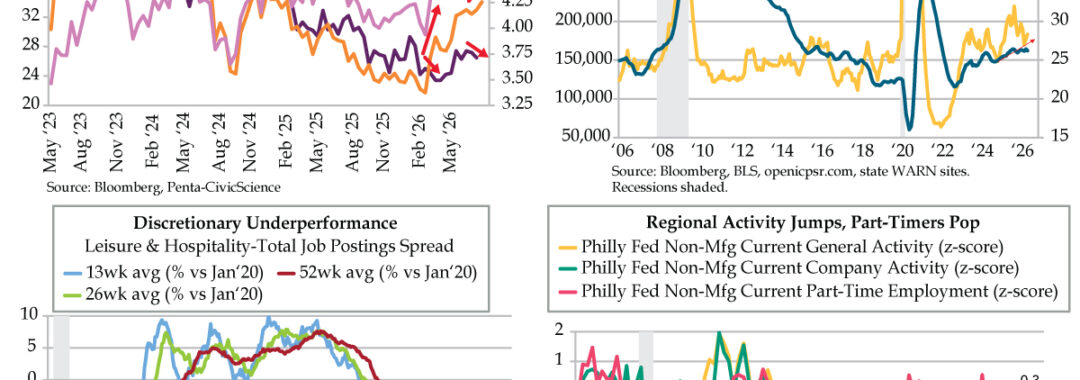
Despite its predictive shortcomings, New York factories are a lens into the interconnected global industrial supply chain; there are still valuable nuggets to prospect. December flashed hope from upstream producers to recoup lost profit margin. Future Prices Received rose 5.2 points to 46.5 (red line), a level solely on par with the post-COVID bulge and the months immediately preceding the credit event that catalyzed the Great Recession, i.e., Lehman’s failure.
Interestingly, this contradicted the report’s other price metrics. Future Prices Paid broke support, falling 7.1 points to 55.4 (blue line), the lowest since January. Even more pressure came off present costs, with Current prices paid dropping 11.4 points to 37.6 (yellow line). The 4.2-point decline in current prices received to 19.8 (green line) adds a third disinflationary reading. Notably, while the so-called current margin spread (i.e., received to paid) compressed to its lowest since January, at -17.8, this occurred not due to improved pricing power, but materials’ costs cooled.
A glance at two leading indicators corroborated disinflation. December’s Current New Orders shifted into neutral (0.0 from 15.9 prior), refusing to hit escape thanks to a pattern in the last 18 months’ ups and downs. At 4.90, Current Inventories running north of demand also re-inverted the New Orders-Inventories spread for the first time in three months, a ‘no confidence’ vote for near-term factory output prospects (aqua line). Moreover, persistently contracting Current Backlogs since June worsened to -14.9 in December, the weakest print in 23 months (fuchsia line). Weakening in this labor demand leader flags fragility in Current Employment (7.3) its Workweek counterpart (3.5).
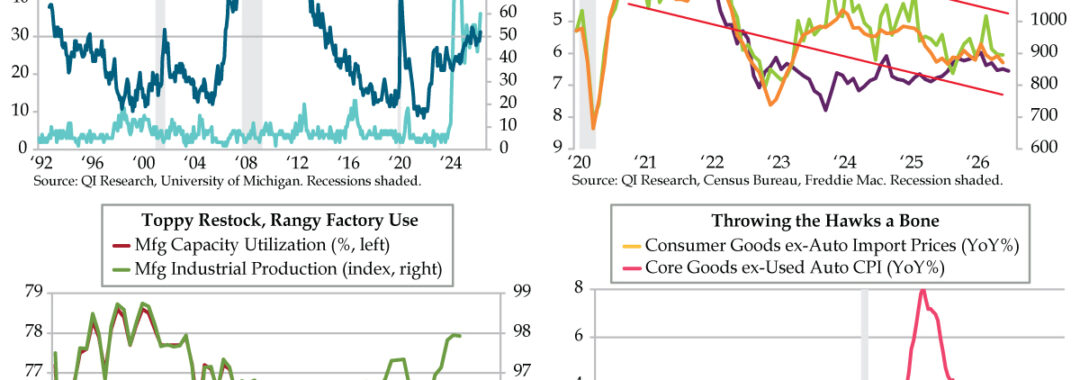
The New York Fed wasn’t the only candidate to be noise-canceled. NAHB’s Home Builder Sentiment index has quadruple-dipped in the last few years. With blinders on, these oscillations are akin to investor positioning swinging from risk-on to risk-off in a range trade. Hindsight reveals a home building slump since the headline number first hit December 2022’s bottom. This December’s eight-month high of 39 is cold comfort as it intersects with the lead-in to the 1990-91 and 2007-09 recessions (purple line). Ditto for Future Sales (lime line) and Buyer Traffic (orange line), at 52 and 26, respectively.
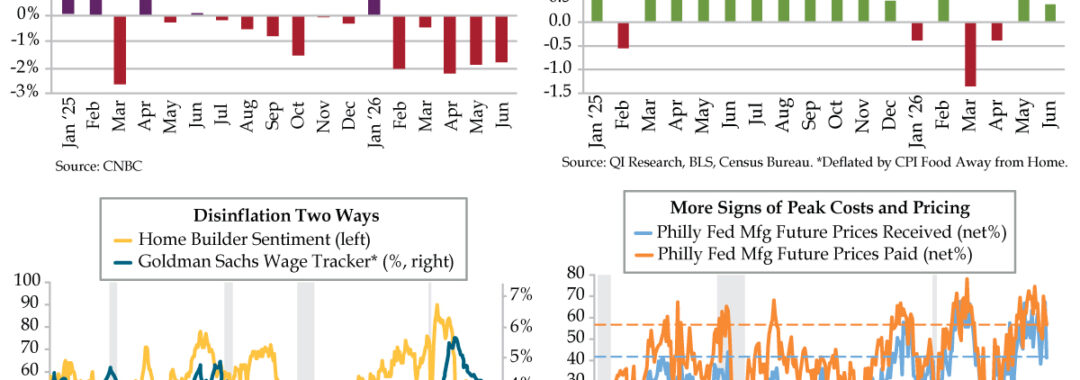
Excerpts from the home builders’ report piled onto the disinflationary theme. NAHB excerpts were the tell: “Market conditions remain challenging with two-thirds of builders reporting they are offering incentives to move buyers off the fence…The use of sales incentives was 67% in December, the highest percentage in the post-Covid period.” Heightening promotional activity is happening alongside a higher cost and supply environment: “Meanwhile, builders are contending with rising material and labor prices, as tariffs are having serious repercussions on construction costs…Rising inventory also has increased competition for newly built homes.” Two words: Margin Squeeze.
As our colleagues at Zelman & Associates summed it up: “For the year, the NAHB’s sentiment index averaged a reading of 37, down from 45 in 2024 and representing the lowest level since 2012 (34).”
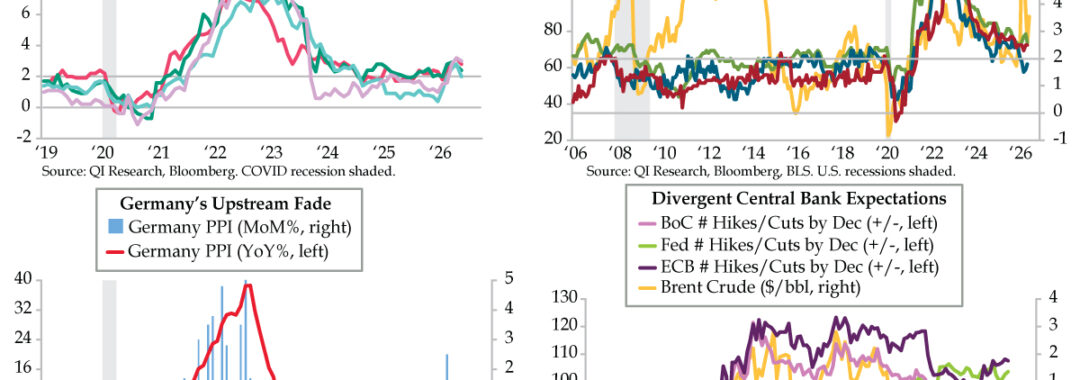
Peering into the jobs picture as we await today’s Bureau of Labor Statistics’ (BLS) coming back out party, macro analysts have no choice but to turn up the noisy volume of withheld income tax receipts. By no means is the series captured from the Daily Treasury Statement a useful guide for monthly nonfarm payrolls: its value comes from its year-over-year (YoY) trend. As volatile as it is, ongoing episodes above and below the longer run average of 4.5% YoY make for points of reference (lilac line). To wit, subpar withheld performance from late-2022 to early-2024 saw the trend in nonfarm payrolls downshift from 4.5% YoY to 1.5% YoY.
Since then, alternating above-and below-normal figures halved it further, to 0.8% in the 12 months ended September (teal line). With both November (0.8% YoY) and December’s preliminary number (3.1% YoY) running under the long-run average, a continued deceleration in the official statistics seems likely when the BLS catches us up to November this morning. Should the downshift be realized, the noise from tax receipts would ratify what countless other sources have long since communicated: slower job growth is at the epicenter of weakening U.S. fundamentals.