The Long Arm of Benjamin Franklin

In 1786, Benjamin Franklin invented a clever way for reaching and taking down books from hard-to-reach shelves. He explained in his autobiography: “Old men find it inconvenient to mount a ladder or steps for that purpose, their heads being sometimes subject to giddinesses, and their activity, with the steadiness of their joints being abated by age; be-sides the trouble of removing the steps every time a book is wanted from a different part of their library. For a remedy, I have lately made the following simple machine, which I call the Long Arm…All new tools require some practice before we can become expert in the use of them. This requires very little. Made in the proportions above given, it serves well for books in duodecimo or octavo. Quartos and folios are too heavy for it; but those are usually placed on the lower shelves within reach of hand. The book taken down may, when done with, be put up again into its place by the same machine.”
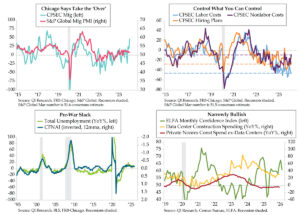
Two hundred and forty years later, the North American industrial supply chain is getting grabbier by the month. S&P Global reported February manufacturing delivery times, inverted to be equivalent to the ISM’s (Institute for Supply Management) scale, lengthened in the U.S., Mexico and Canada to 54.6, 55.5 and 54.5, respectively. The U.S. ISM measure echoed this development, rising to 55.1 in February (fuchsia line). The average of the former three, 54.9, was a cycle high; the ISM series was one point from pushing through the May 2025’s high point of 56.1 of the last several years.
Slower delivery times are capitulating into greater price pressures. Danielle summed it up in yesterday’s QI Pro chat: “Prices paid screams paying up to restock.” To that end, February’s figure began just the third episode north of the heightened 70 mark (yellow line) since 2015 – Trade War 1.0, COVID-19 and Trade War 2.0. ISM explained: “The Prices Index reading continues to be driven by increases in steel and aluminum prices that impact the entire value chain, as well as tariffs applied to many imported goods. Higher prices were reported by 45.4 percent of respondents in February, up 16.4 percentage points from January’s 29 percent but lower compared to the 49.2 percent in April 2025, which was the highest share since June 2022 (65.2 percent).”
Nowhere was the grabbiness more obvious than in the ISM Import index. Jonathan shared with the QI Pro chat: “Less in the way of New Orders (55.8 v 57.1) and Production (53.5 v 55.9) and more from Imports (54.9 v 50.0, purple line) points to the restock sourced from outside the U.S. Since the 1989 inception of the ISM Import index, the two-month gain of +10.3 points, from December to February, was the largest on record, outside of the pandemic. Then pile on energy shock playing out in March,” and supply chain price pressures will getting worse before they get better. This price risk is not being captured yet by one-year inflation swap rates. The current 2.62 figure was nearly in line with January’s month-end number of 2.65 (light blue line).
GDP math dictates that accelerating imports will compress top-line growth. The Atlanta Fed’s GDP Nowcast incorporates the ISM Manufacturing index. February data had no material impact, keeping the Nowcast at a 3.0% annualized rate for 2026’s first quarter. The story doesn’t end there. Other parts of the ISM survey also could have indirect influence on the real-time growth tracker.
Over time, the ISM Imports index has become a more relevant directional beacon recently. Since the 2011 inception of the Atlanta Fed gauge, rolling 12-month correlations between ISM Imports and Atlanta Fed GDP have never been more inversely correlated than over the last 12 months, running in the vicinity of -.70. The second quad chart depicts the ISM series shifted one month forward to be aligned with the concurrent news flow and subsequent model adjustments. The latest 3.0% figure (orange line) overstates the growth situation that the inverted Import index implies. Therein lies the risk from the next round of official trade statistics.
Ocean shipping trends help with tracking the mosaic of U.S. trade inflows. If only there was an ETF that tracks global shipping? Enter the SonicShares Global Shipping ETF, ticker BOAT. Its website explains: “The Index consists of global shipping companies engaged in the maritime transportation of goods and raw materials, including consumer and industrial products, vehicles, dry bulk, crude oil and liquefied natural gas. Maritime shipping is considered the lifeline of the U.S. and global economies, as around 90% of the world’s trade is carried by sea.” In the short history depicted, BOAT has steered a similar, earlier tack than ISM Imports. If the advance thus far this year (aqua line) is accurate, then the ISM Import climb is not yet complete and neither is the restock narrative.
The transitory tightening in the industrial supply chain is colliding with the long arm of a loosening in the labor cycle. Indeed’s Wage growth tracker fell to a 2.0% rate in January (red line), a smidge above the 2020 low point. Indeed’s grind lower suggests there will be more easing in wage pressures via the official average hourly earnings trends for all employees and workers (green and dark blue lines). Because the restock in manufacturing activity is generating some heat, the cooling in wage trends likely is more a broader service sector story. All told, Indeed’s guidance points to the potential for a downside surprise in wages come Employment Friday.