The Daily Feather Sample — Ease Button

QUICK QUILL — Lower recession probability prompted by brightening expectations in Germany is a green shoot worth monitoring. Back in the States, consumer purchasing power has darkened as income gains wither amidst job cuts even as essentials inflation refuses to abate. The ‘tell’ would be slower consumer spending growth that threatens to fall to such an extent we hear more reports of U.S. households reducing the volume of groceries they can afford to buy. Until Powell sees the whites of the eyes of an unemployment rate with a 4-handle, TIPS investors will have to wait longer to back up the truck and become bullish.
 

TAKEAWAYS

  1. The consensus expects headline PCE to hold at 0.3% MoM in April while core PCE falls a tenth to 0.2% MoM; however, UMich’s preliminary May data gave no signs of cooling, with Bad News about Higher Prices climbing to a 6-month high of 17%, tripling the 5% average
  2. From Q1’s local high of 48.7, the UMich News Heard-Higher Unemployment Expectations spread has since more than halved to 20.0 in May; the downshift suggests real consumer spending has more room to fall after slipping from 2.7% YoY in Q4 2023 to 2.4% in Q1 2024
  3. TIP, the largest Treasury Inflation-Protected Securities bond ETF, is currently trading well below its post-pandemic highs; so long as Powell is able to point to the lack of forward progress on Supercore as reason to remain Higher for Longer, this looks set to continue


Of the forty hard jobs listed by CareerAddict.com for 2023, two stood out as especially life-threatening – cell tower climber and explosive ordnance disposal specialist. When scaling a tower, you could certainly fall, get your hand crushed, or even get struck by lightning. Detonating or diffusing live bombs would seem to be self-explanatory. Should you cut the red or the blue wire? If it wasn’t your bread & butter, you could romanticize about starring in your own Mission Impossible. In 2005, Staples introduced a fictional fix for real-life dangerous day jobs. It’s advertising agency, McCann Erickson depicted challenging tasks, like a cowboy wrangling a bucking horse and a father changing his twin infants’ diapers. In each case, pushing an “Easy Button” did the trick. The baritone voice-over would then say, “Wouldn’t it be nice if there was an Easy Button for life? Now there’s one for your business. Staples. That was easy.”

In 2008, Staples revived the campaign to “tackle” high prices. In each spot, a shopper is appalled at the price quoted for their purchase — whether gasoline, food, or clothing. The solution: Push the Easy Button and ask if that would make it any less expensive. Needless to say, the answer was always no. The post-pandemic era has been woefully bereft of Easy Button opportunities, even in jest. In the case of the United States, fiscal stimulus gone wild trained countless consumers to live beyond their means for “free,” and continue to do so using debt. In Europe, while there was less in the way of fiscal assistance, relatively stronger strictures on job cutting have helped.

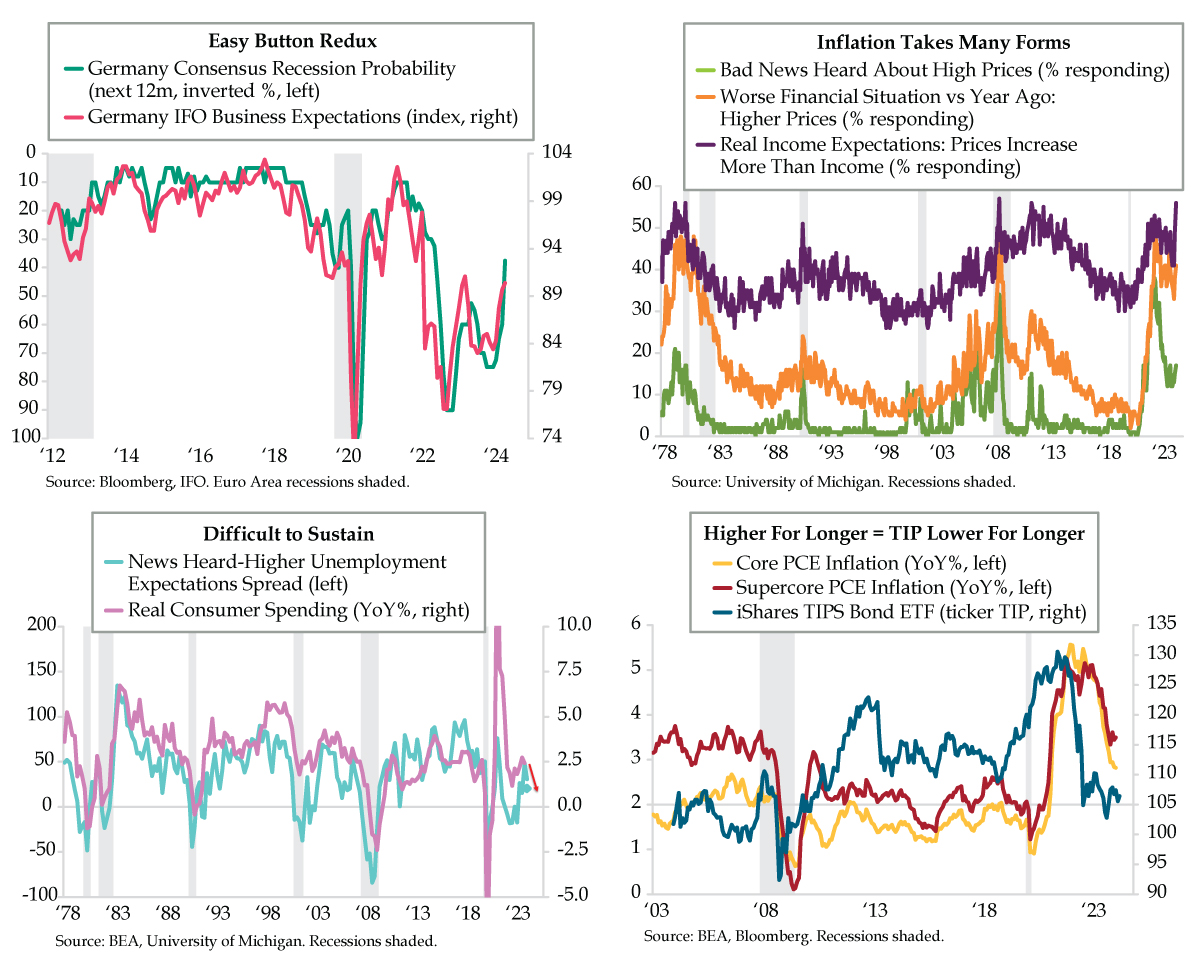
As for inflation, households on both sides of the pond have been largely helpless to fend off inflation over which their respective central banks hold little sway, particularly that of food and energy. Any good news is greeted with open arms as was the case with yesterday’s release of IFO Business Expectations (fuchsia line). Not only does it have an uncannily accurate relationship with recession probabilities in Deutschland (inverted teal line), expectations brightened to such an extent, they sent recession odds under 50% for the first time in two years.

Closer to home heading into a holiday-shortened trading week, the Federal Reserve’s preferred inflation gauge holds the most potential to move markets when it’s released Friday. Consensus is calling for April’s headline personal consumption expenditures (PCE) price index to stay steady with that of March – holding at 0.3% month-over-month (MoM) and 2.7% year-over-year (YoY). The core PCE, however, is expected to cool a tenth to 0.2% MoM, which would maintain its annual pace at 2.8% YoY (yellow line).

Last Friday’s University of Michigan (UMich) preliminary May consumer survey refuted any notion of cooling. Unfavorable News Heard About Higher Prices rose two points to a 6-month high of 17%, more than three times its 5% long-run average (green line). An elevated 41% said their Current Financial Situation had worsened due to higher prices, more than 17% norm (orange line).

Finally, a near record 56% believe price increases will more than offset income growth in the next year (purple line). There is decidedly more afoot than rising prices given May’s downticks for 1-year and 5-10-year UMich Inflation Expectations. The 15-point, two-month vault is unprecedented since the series 1978 inception.

The missing link: PRICING POWER. It’s not that inflation in isolation has resurged, so much as it being a case of inflation not keeping up with diminished incomes as job losses mount. Recall last week’s “Guardians of Gaslighting,” highlighted a Harris poll covered by The Guardian which found 49% of Americans “wrongly” thought the unemployment rate was at a 50-year high instead of it being the opposite case.

Not reporting true labor market data has apparently begun to grate on working Americans. Imagine that. In the meantime, two-thirds of U.S. economic output is comprised of consumption fueled by shrinking paychecks in the aggregate. Given surging credit card charge-offs, absent a continued spike in Buy Now Pay Later, we look to the spread between UMich News Heard-Higher Unemployment Expectations as a guide. It combines all buckets about recent changes in business conditions and contrasts it with households’ fear concerning future job loss. After 2024’s first quarter local high of 48.7, this metric has more than halved to May’s reading of 20.0 (aqua line). Heeding to pressures emanating from the labor market, the trend in real consumer spending already has eased from 2.7% YoY in 2023’s fourth quarter to 2.4% in 2024’s first quarter (lilac line).

Will policymakers at the Fed, who will put us out of our misery by entering FOMC blackout come Friday, be swayed by collapsing household perceptions of the job market? We doubt that seriously. Tourists would agree – that is, passive investors in the asset class designed to protect against inflation. The largest Treasury Inflation-Protected Securities bond exchange-traded fund, ticker TIP, is still trading well below its post-pandemic highs (blue line). The price of TIP is effectively the mirror image of real rates staying Higher for Longer to combat core inflation, which we’ve been told is too sticky and too steep for policymakers’ liking. To be sure, idiosyncrasies attendant to the vagaries of insurance rates and other sources of inflation out of the Fed’s control have stalled disinflation in Supercore PCE (red line). Such realities still won’t prompt Powell et al to whip out the Ease Button.
 

THE FEATHER WITH NO TITLE

Welcome to Quill Intelligence

Please sign in or hit subscribe above.

Thank you for visiting,

The Quill Intelligence Team


No Shill for QT


Recently, my integrity was publicly questioned. It was deeply unsettling. The accusations, and there were a handful, was that I was a “shill,” hawking the Federal Reserve’s policy of Quantitative Tightening (QT) even though, in truth, the Fed was still engaged in Quantitative Easing (QE). After the anger faded, replaced by benevolence for those who fundamentally misunderstand the Fed’s public blueprint (linked here) to phase in QT, the wordsmith in me took over.

“Shill.” What a word! According to the original 1914 entry in the Oxford English Dictionary (OED), the verb’s definition is circular: “to act as a shill.” The noun, however, is much more satisfying: “a decoy or accomplice, especially one posing as an enthusiastic or successful customer to encourage other buyers, gamblers, etc.” Though the OED declares of the word’s etymology, “unknown,” the Chambers Dictionary of Etymology connects the word “shillaber” originally associated with a “circus or carnival. Additionally, Chambers proposes that the “shilling,” a former British monetary unit, is derived from an Old Frisian or Old Saxon coin called the skilling, which itself is derived from one of three ancient roots: skell (to resound), skel (to divide, as of gold or silver), and skeld (shield).

Skepticism surrounds this interpretation given hard money, by definition, is not false. Decisive actions are, conversely, true. The sheer level of misinformation swarming my Twitter feed and that of other “shills” for the Fed’s “fallacious” QT prompted me to reach out to Joseph Wang, who hangs his hat in Estonia these days. In his past life, Wang was a senior trader at the New York Fed. Yes, he does know a thing or two about the workings of the Fed’s balance sheet.

After last week’s latest batch of conspiracy-theorist teeth-gnashers sprang free spewing more nonsense yet on my feed, I reached out and asked Wang what was so hard to understand about the maturity schedule of Treasuries that’s prevailed since we first took Finance 101. I was one of the first to Tweet that the Fed’s QT could not start until June 15th, the first maturity date after the campaign was underway. This would be followed with more roll-off on the last day of the month and ramp up to full throttle by the end of September as clearly depicted above. Rather than empathize, Wang graciously offered to appear as a guest to set the record straight in a straightforward manner, via a QT Primer. With that, I hope the QI community can join me in welcoming Wang’s insights.

Yes, Quantitative Tightening Really Is Happening

The Fed is executing QT exactly as it promised, even if it may not appear that way. Fed data seems to indicate that they are not hitting their monthly QT targets (or maybe even purchasing more assets), but such conclusions reveal an inherent misunderstanding of certain details of the Fed’s balance sheet. This post seeks to dispel this misunderstanding by showing how Treasury Inflation Protected securities (TIPsa) adjustments inflate the size of the Fed’s Treasury holdings, and how the timing of MBS purchases settle obscure declines in Fed MBS holdings. QT is in train, and it will become even clearer when the pace picks up in September.


Fed is Not Buying Treasuries 

The Fed’s Treasury portfolio continued to grow even after QE due to principal adjustments from TIPs, a type of Treasury intended to protect the investor from inflation by adjusting the principal of the security each month by CPI. For example, $100 principal invested in TIPs would be adjusted to $110 principal after a year of 10% inflation. The Fed’s $370 billion holdings of TIPs is increasing due to elevated inflation, which is also separately broken out as “inflation compensation.” That growth in turn shows up as small but steady increases in the total Treasury holdings.

Since the advent of QT, Fed Treasury holdings have dropped steadily at a rate equal to the monthly QT cap. Fed Treasuries holdings decline discretely on mid-month and month-end because those periods are the time of month when most Treasuries mature. Mid-month and month-end are also the periods when newly issued Treasury securities are settled, allowing investors to easily roll over their maturing holdings into newly issued Treasuries. The Fed also reinvests any maturing Treasury principal in excess of its QT cap into newly issued Treasuries.


MBS Holdings Really Are Declining

The Fed’s MBS holdings are decreasing, even if this is obscured by the sawtooth pattern of its holdings, which arises from the repayment and settlement schedule of MBS, wherein MBS bonds receive principal repayments on the 25th of the month and newly purchased MBS settle on the 15th of the month. The spikes in Fed MBS holdings arise from the settlement of newly purchased MBS; the declines are due to principal repayments. The Fed is still receiving MBS principal repayments each month that must be reinvested, so its MBS holdings continue to show periodic spikes even as overall MBS holdings are declining.

The Fed’s policy of settling MBS purchases within a three-month window adds another wrinkle to understanding Fed MBS holdings. The Fed is the largest investor in the MBS market and aims to minimize any potential disruption by postponing MBS settlement if it judges that postponement would improve market functioning. This means some of the increases in the Fed’s MBS portfolio could arise from purchases conducted three months ago, including purchases from reinvesting principal received the period between the end of QE and the start of QT. These delayed settlements are recorded as commitments to buy MBS and have steadily declined over the months. These commitments obscure the steady drop of Fed MBS holdings but will dissipate in a few months.


Just Wait for September

QT is taking place exactly as the Fed has telegraphed and the balance sheet declines will become more apparent in the coming months. Soon the QT pace will quicken, and all past-purchased MBS will have settled. From that time, the Fed’s balance sheet will clearly and steadily decline each month.

If you are interested in having a deeper understanding of how liquidity flows on the Fed’s balance sheet, you can check out my online course on the subject.


Thank you, Joseph.

One last note on MBS. If the Fed does deploy the nuclear option and sells MBS outright, which is doubtful, and incurs a loss, the law allows the Fed to amortize for 10 years said loss by way of a 1/10th per year reduction in remittances it sends every one of those 10 years to the Treasury Department. As much as it might anger Elizabeth Warren, such an outcome would not mean the Fed was insolvent. Much more likely, as Powell has indicated, QT shifts to Treasuries making up for any MBS QT monthly deficit to offset what’s not satisfied under the cap due to insufficient prepayments.